Olympia Maximatic (Coffex/Livietta)
$1250.00
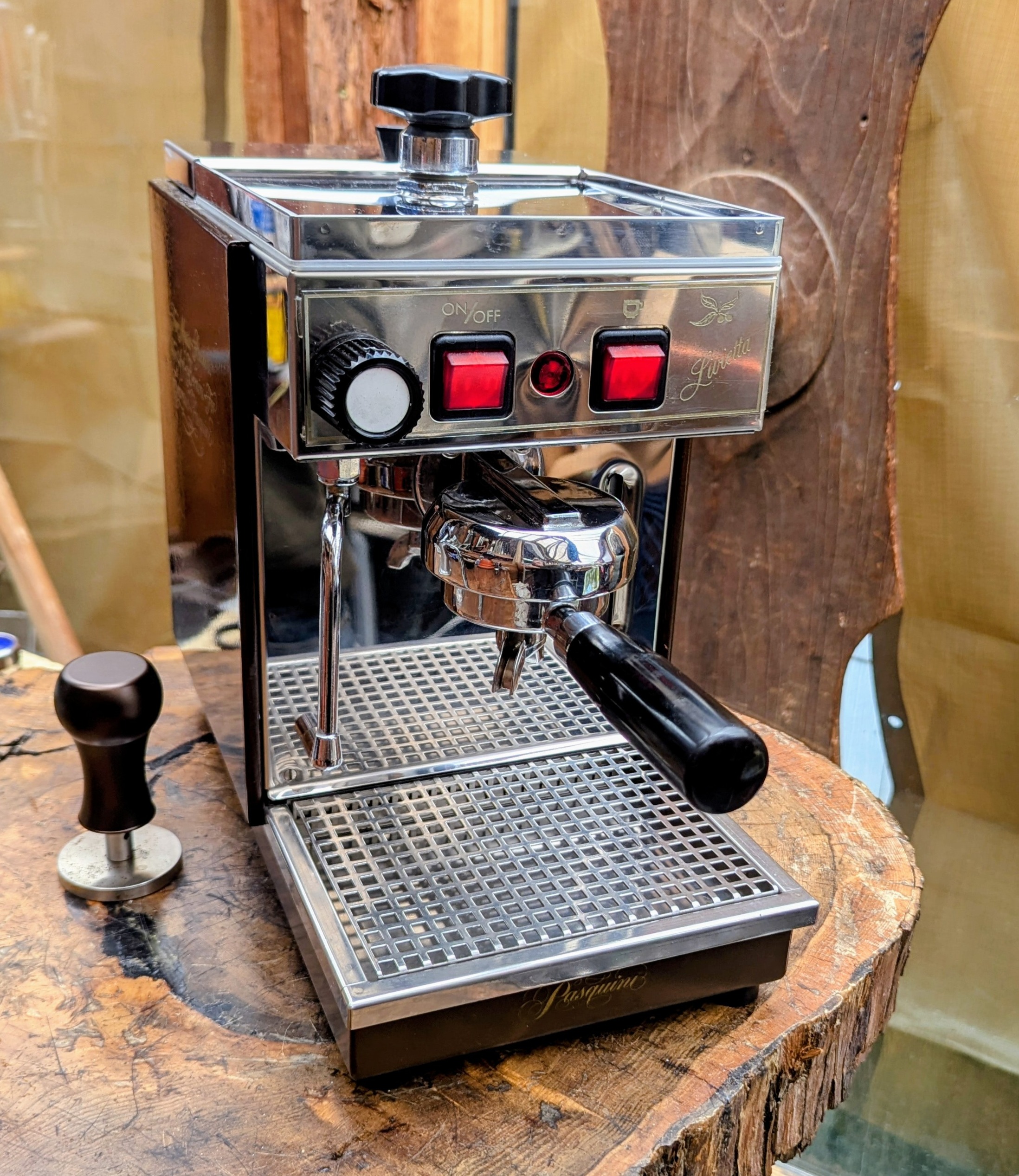
A super clean '85 Olympia "Maximatic." Seriously. It's gorgeous. You may be able to find a physical flaw if you look hard enough (ok, there is the obligatory Olympia corner paint chip on the front right edge of the brown case) but there's barely a scratch on this handsome Forty-Something. So we're dubbing it the "Immacumatic."
Inventing our own name is appropriate because these machines were marketed in the early '80s under multiple aliases. We joke it's the Olympia "that shall not be named."
European models were known as "Maximatic." The US version was called "Coffex." And adding to the confusion, the Pasquini Company in Los Angeles put their own name on the ones they sold, calling them the "Livietta." (Like this one.)
(Pasquini contributed even more opacity to the history of the name by somewhat cynically branding a later machine the "Livietta 2," which sadly had zero connection to Olympia. But that confusing past means you may luck into an "original" Olympia Livietta getting past the ebay flippers, and find a bargain.)
Olympia even changed the group a year or two after production began, going from their small 49mm standard (Cremina size) to a more appropriate 54mm, which only meant even more variations!
(The company was obviously hoping to use the Cremina portafilters for both, before realizing the limitations of a small group mated to the theoretically unlimited water flow with an electric pump!)
Why they didn't go with a "commercial" standard 58mm size group at that point probably had do with scale. The compact Maximatic would look pretty awkward with a much larger group bolted on.
Regardless of the motive, that decision has meant the only reliable way to get replacement portafilters and baskets, is to buy them directly from Olympia. Locking people into an Applelike closed ecosystem can be a little annoying. But the "good part" is Olympia sells quality stuff.
As with all Olympia machines, the Maxi was expensive in it's day, and aimed at the upper end of the market. Which means there's never been many around for resale. So it's understandable why even serious vintage espresso fans often know so little about them.
Whichever name is on yours, the takeaway is: They're basically all the same.
And basically the same as the "Maximatic" that Olympia sells today! 40 years later! The only major change being the addition of a pressure gauge.
The fact that so few people are familiar with the history, doesn't mean the machines weren't/aren't amazing espresso producers. They were, and still are. They live up to the Olympia build and design quality their older brother "Cremina" has made legendary.
In the Maxi's case, that included them being built with "commercial" instead of consumer components (pump, solenoids, etc.) And because they're Olympia, they managed to shoehorn all that extra stuff into a footprint only slightly larger than the Cremina.
It's funny how much Olympia stayed committed to their "less is more" aesthetic, and still competed in the US, at a time when Americans were all about "bigger is better." Olympia's obvious culture of efficiency over bling has aged well, and makes even more sense now to a generation of Americans living with limited space.
In fact, the original Maximatics may be the most compact "semi-pro" espresso machine ever built.
Part of what makes them "semi-pro" is the heat exchanger design. You've probably heard that means a user can "brew and steam at the same time." But the real point of a heat exchanger (a pipe runs through the boiler with the brew water, heating as it passes through, while the boiler water provides steam) is that it's a de facto "double boiler." (Before double boilers were a thing, and now Holy Grails to tech bros of the espresso world.)
On a Maximatic, that means there are two places to add water. A reservoir under the lid at the back holds the brew water that pulls the shots, and a steam boiler that is filled by removing the cap on top. (When cool!)
Maintaining both is important, because while running the brew reservoir dry merely stops water flowing out of the group (though you may end up with a temporary "vapor lock" issue as a result) running the boiler dry risks damaging the heating element. With the cost of parts from Olympia, that's not a place you wanna go.
We know it's boring hearing us repeat the mantra, but don't go off and leave a vintage espresso machine on. (And don't ask how we learned this.)
Fortunately, monitoring the boiler water level is what the sight glass is for on the right side of the fascia panel. (By the way, check out that mirrorlike fascia panel! We polished it a little, but it was near perfect to start with, and we just don't see 'em like this very often!)
Olympia also incorporated a "three way" exhaust valve on the Maxi. A pioneering feature on a "home" espresso machine. Like the big boy machines at commercial cafes, the valve opens after you switch off the pump to stop the shot, venting leftover water pressure through a tube to the drip tray. That helps prevent "blow back" laundry accidents when unlocking the portafilter! (But means you have to drain the tray semi religiously.)
Olympia's cool proprietary pressurestat (same as Cremina) is heavy duty, seems to last forever, and is easily adjustable (it controls boiler pressure, which let you adjust water temperature.) Unlike the cheap pressurestats of virtually every other "home" espresso machine.
There's also a boiler "overheat" protection switch that should theoretically blow if you still accidentally "go off and leave your machine on" (despite our nag) and have it run dry. Hopefully that saves the element, and re-settable with a button on the bottom when you get home.
All these features added up to one of the best "domestic" machines you could buy at the time. And it still ranks up there. They still pull an amazing shot once you get your dose and grind figured out. (As many Olympia nerds will attest.)
Yeah, Maximatics require some experimenting with grind and dosing to find Crema Nirvana. It seems to like a slightly coarser grind, and leaves wetter pucks, even after you get it dialed in. Not sure why, but maybe the perforated holes are slightly narrower in the portafilter basket than most brands.
Not a big deal in our estimation, but something to know when considering a Maximatic.
Though it really was "gorgeous" when we got it, we ended up tearing it apart, and putting it back together, as usual. So the machine has a complete group rebuild, de-scale, sight glass seals, new cap seal, pressure adjustment, new group screen, new double portafilter basket, and even a new heating element. It should be trouble free for a long time.
(The heating element actually "worked" in a regular outlet, but would blow a GFCI. Which meant there was a short somewhere. As it turned out, a pinhole leak in the original element was the culprit. Time and electrolysis takes it's toll on even well maintained machines. And heating elements are one of the few things to "watch out" for with vintage Olympias. Test with a volt meter, or a GFCI before you buy from a stranger if you can.)
Considering the cost of a new Maximatic, the value of an earlier model in this condition is pretty hard to deny.
There's an intrinsic "Joy" built into this era of Olympia espresso machines. Being able to use one every morning, makes getting up a lot more fun. It should be hard for an "Earthly possession" to deliver that kind of transcendent "experience" on a daily basis, but ask an Olympia owner if we're making it up.
Like Creminas, the original Maximatics are only getting harder to find and more expensive. We wish that wasn't true, but it is. Perhaps the best thing we can say about that phenomena is in a couple years this one may seem "cheap."
Sold with new spring loaded tamper, and an extra double basket.